Information
for patients
On this page, we would like to provide you with a clear and easy-to-understand overview of the various intraocular lenses (IOLs) available.
Our aim is to make the often highly technical information about the different lens models and their characteristics as accessible as possible.
This will allow you to familiarise yourself with the various options at your leisure and gather initial questions for your personal consultation.
Please note that the content provided here is intended as an initial guide and cannot replace a personal consultation with your treating doctor. Which intraocular lens is best suited to you depends on your individual circumstances, your visual needs and your personal expectations.
All further information, a detailed explanation of the various lens options, and a joint assessment of the options available to you will take place during a face-to-face consultation at your clinic or doctor’s surgery.
Our aim is to prepare you as well as possible for this consultation – so that you go into it well-informed, can address your questions specifically, and make a well-informed decision together with your treatment team.
There is a wide variety of IOLs – here we provide a brief overview of their differences
An EDOF (Extended Depth of Focus) lens is a special intraocular lens (IOL) that is implanted during cataract surgery and enables an extended range of vision.
It generally provides good vision at a distance and at intermediate ranges, for example when driving, using a computer or looking at the dashboard.
Compared to other IOLs, the EDOF lens focuses on providing continuous vision across an extended focus range, often with fewer distracting light phenomena.
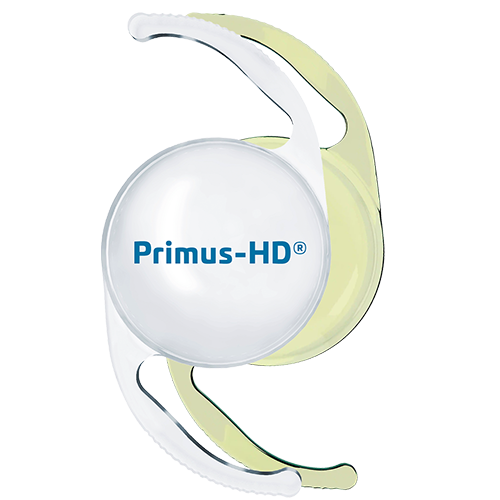
A hybrid trifocal lens is an intraocular lens (IOL) that combines the properties of different optical technologies to enable good vision at a distance, at intermediate ranges and up close.
For example, it combines the advantages of trifocal optics with an extended depth of focus (EDOF front surface) to achieve the most continuous visual range possible.
The aim is to minimise the need for spectacles in everyday activities such as driving, using a computer and reading.
A Monofocal Plus lens is an intraocular lens (IOL) that offers an extended visual range compared to a conventional monofocal lens.
It enables good distance vision and improves vision in the intermediate range, for example when using a computer or looking at the dashboard. Reading glasses are often still required for reading small print.
The aim is to provide an extended visual range whilst maintaining good visual quality and, in most cases, minimising bothersome light phenomena.
An aspheric monofocal lens is an intraocular lens (IOL) that is optimised for a specific visual range – usually distance vision. Its special aspheric design can reduce aberrations and improve contrast.
Advantage: Clear distance vision and good contrast perception, usually with few distracting light phenomena.
Disadvantage: Glasses are usually required for intermediate and near vision.
With our IOL simulator, you can clearly experience how different intraocular lenses vary under different lighting conditions and across different ranges of focus. Compare the visual impressions shown and gain an initial understanding of how the various lens types can influence vision.
With this simulator, you can compare vision before and after cataract surgery or contrast different lens models.
To do this, select the desired lens model at the bottom right or the models you wish to compare at the bottom left and right.

A personal testimonial that offers encouragement.
What is it like to discover new perspectives on vision with the ALLRAGE IOL?
An authentic patient testimonial provides insights into personal experiences and shows how a bespoke lens solution can positively impact quality of life. Be inspired and find out first-hand what this decision can mean for everyday life.

A personal testimonial that offers encouragement.
For a chef, good vision is crucial – every day, with every movement.
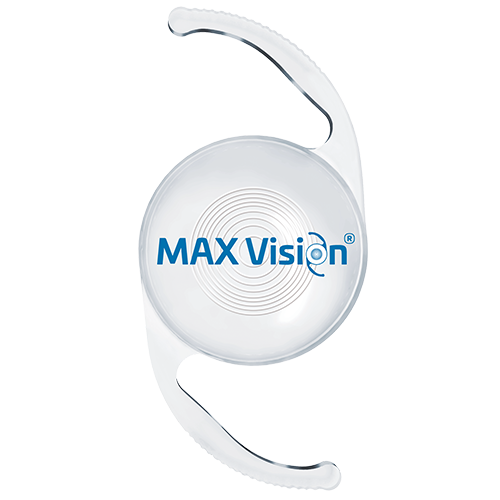
In a personal account, the patient explains how the MaxVision lens has changed his life and how he can now carry out his profession with joy and confidence once again. His story offers encouragement, instils confidence and shows just how valuable good vision is for quality of life in everyday life and for professional fulfilment.
A new outlook on life – seeing what really matters.
Sometimes, taking the step towards better vision is easier than expected.
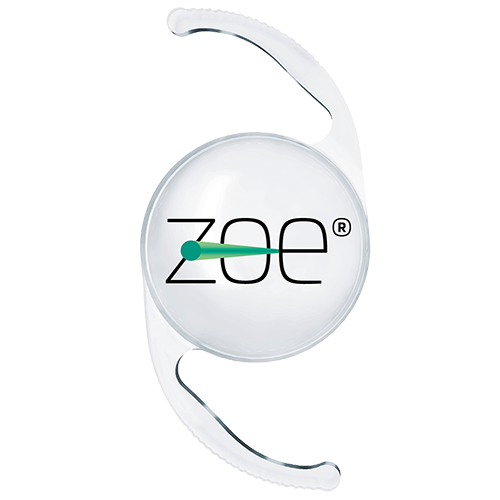
In her personal statement, a patient explains how straightforward she found the ZOE lens implantation procedure and how liberating it feels to perceive the world more clearly once again. Her story offers encouragement, allays any fears and powerfully conveys just how much quality of life can be gained from rediscovering the things of everyday life.
‘Cataract’ is the medical term for a cataract. It refers to the natural lens of the eye becoming increasingly cloudy, causing blurred vision, colours to appear less vivid and, often, increased sensitivity to glare.
Treatment usually involves surgery, during which the cloudy lens is removed and replaced with an artificial IOL lens.
An IOL (intraocular lens) is an artificial lens that is implanted into the eye to improve vision. It usually replaces the natural lens of the eye – for example, during cataract surgery – or corrects certain refractive errors. Depending on the type of lens, it enables sharp vision at different distances.
An aspheric lens is a lens whose surface is not uniformly spherical in shape. This enables it to reduce certain optical aberrations and provide clearer, higher-contrast vision.
In the case of an IOL in the eye, this means that an aspheric intraocular lens can help to reduce disruptive optical aberrations – particularly in low light conditions.
In short: aspheric lenses are designed to project the image onto the retina as precisely as possible, thereby improving the quality of vision.
A toric IOL is an artificial lens that, in addition to correcting short-sightedness or long-sightedness, can also correct astigmatism.
It is used, for example, during cataract surgery to replace the natural lens of the eye.
In short: a toric IOL helps to reduce blurred or distorted vision caused by astigmatism, thereby enabling clearer vision.
stigmatism is the medical term for a curvature of the cornea.
This occurs when the cornea of the eye is unevenly curved. As a result, light is not focused evenly, meaning that objects may appear blurred or distorted – both close up and at a distance.
In short: astigmatism can cause your vision to be less than perfectly sharp. A toric IOL can specifically correct this vision problem during eye surgery.
The refractive design of an IOL describes how the lens refracts incoming light through the curvature of its surface, thereby focusing the image on the retina.
Certain IOLs utilise this principle to enable vision at different distances.
In short: the refractive design determines how the artificial lens directs light to produce the sharpest possible image.
A diffractive design in an IOL uses fine, ring-shaped structures on the lens surface to specifically distribute the incoming light to different focal points via diffraction.
This enables the lens to support vision at multiple distances, for example, both far and near.
In short: whilst a refractive lens primarily directs light through refraction, a diffractive lens also utilises the diffraction of light to cover different visual ranges.
One potential drawback is that diffractive lenses can cause light phenomena such as halos (rings of light) or glare in some people.
Mini-monovision is a visual concept in which, following cataract surgery or a refractive procedure, one eye is adjusted for distance vision and the other is slightly adjusted for near vision.
Dominant eye: optimised for distance vision.
Non-dominant eye: set to be slightly short-sighted to support near and intermediate vision.
The difference between the eyes is less pronounced in mini-monovision than in classic monovision. This can improve independence from spectacles, whilst spatial vision is usually better preserved.
Aim: The best possible visual comfort for distance and intermediate vision with reduced reliance on spectacles.
This means:
Up close: Vision is usually good.
At a distance: Objects appear blurred, such as road signs or faces.
Cause: Often, the eyeball is too long or the eye’s refractive power is too strong. As a result, the image is focused in front of the retina.
In ophthalmology, ‘myop’ therefore refers to a short-sighted eye. The opposite is ‘hyperop’ – meaning long-sighted.
Emmetropia refers to an eye with normal vision and no significant refractive error.
This means:
At a distance: You can see clearly without needing glasses or contact lenses.
Optically: Light is focused on the retina in such a way that a sharp image is produced.
In short: Emmetropia means that, when relaxed, the eye is sharply focused on distant objects. The opposites are, for example, myopia (short-sightedness) and hyperopia (long-sightedness).